Mostrando las entradas con la etiqueta Okonjo-Iweala. Mostrar todas las entradas

viernes, 17 de diciembre de 2021

Acto de presentación de las Comunicaciones Ministeriales sobre el comercio, el medioambiente y el desarrollo sostenible

Acto de presentación de las Comunicaciones Ministeriales sobre el comercio, el medioambiente y el desarrollo sostenible 
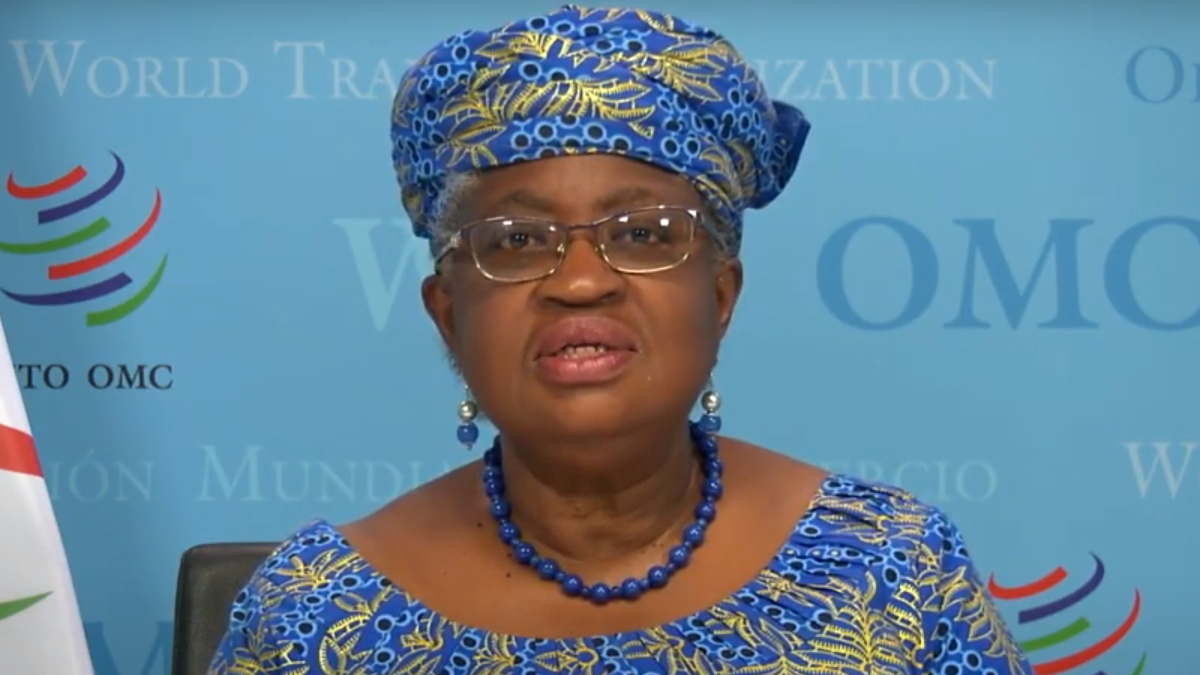
Discurso de apertura a cargo de la DG Okonjo-Iweala
Acto de presentación de las Comunicaciones Ministeriales sobre el comercio, el medioambiente y el desarrollo sostenible

Ministers, Excellencies, dear friends and colleagues,

Let me start by saying “Congratulations!” to the co-conveners; these congratulations are well deserved.  The co-sponsors of these three Ministerial Statements are taking an important step forward on addressing key trade and environmental sustainability issues at the WTO.  It is a very encouraging sign that so many Ministers are joining us today and delivering messages. 

This event was supposed to have taken place during our 12th Ministerial Conference. As you know, we had to postpone MC12 because of recent COVID-19 developments. Disappointing as this was, our work to respond to the challenges of our time — from the pandemic to the environmental crises in our atmosphere and oceans — cannot and must not wait.

You have managed to persevere, to push your work forward and send this clear political signal today that you see trade, trade policy and the WTO as central components of your environmental sustainability efforts.

This is truly a historic moment for the WTO. Environmental concerns were first discussed within the GATT as early as 1971, during the early days of the international environmental movement. But it was not until 1994 that leaders adopted the first Decision recognizing the “mutual supportiveness” of international trade and environmental action and created the WTO Committee on Trade and Environment. There is too much at stake for us to wait decades more for results. Your Ministerial Statements must lead to action. Just last week many of you were part of the conclusion of the joint initiative on services domestic regulation. I hope you will take that as inspiration for delivering results on environmental goods and services, sustainable supply chains, plastics pollution, fossil fuel subsidy reform, capacity building and all the other critical aspects of trade and environmental sustainability in your statements.

When WTO Members launched negotiations on trade and environment issues back in 2001, you were ahead of the curve.  You had identified positive pathways for trade to support the environment, including by facilitating access to environmental goods and services. You also recognized the importance of addressing environmentally harmful subsidies and initiated what at the time were pathbreaking negotiations on fisheries subsidies.

Trade, and the WTO, are part of the solution to climate change and environmental degradation. That was the message I took to COP26 in Glasgow a few weeks ago. I always say that trade is about people. But the fact is that people — in particular, the most vulnerable — are increasingly paying the price of environmental degradation. Problems of the global commons represent some of the biggest threats to the future prosperity and security of people around the world. Today, you are demonstrating that you want the WTO to play a positive role in addressing these problems.

In recent years at the WTO, we have seen renewed interest, including from developing country Members, in sharing experiences and ideas for using trade-related policies to address environmental challenges.  This reflects the growing understanding among Members that trade can and must act in support of achieving sustainable development outcomes for people around the world.

Work in the WTO Committee on Trade and Environment has directly informed the statements you launched.

Let me also commend the participants in all three initiatives for involving external stakeholders in your work — civil society groups, business, and other international organizations. Drawing in the full range of stakeholders is vital for improving our understanding of the challenges and opportunities at the intersection between trade, environment, climate change and sustainable development.

It is very welcome to see that more than half of the 81 co-sponsors across the three statements are from developing countries. I encourage you to continue your efforts to further increase the number of developing and least developed countries in your initiatives.  Inclusiveness of this kind is essential. Developing countries and least developed countries are particularly vulnerable to climate change and other environmental challenges. Every day we see this, from South Sudan to Fiji, to the Caribbean and all over the globe. And they have important innovations, ideas, needs and perspectives to bring to the table, so we must include them.

The needs of poor and vulnerable countries underscore why investment, technical assistance and capacity building, as well as just transition considerations, need to be integral elements of your discussions. As we know, environmental challenges are already complicating efforts to rebuild amid the COVID-19 pandemic. There is a critical role for external support in their efforts to put their economies on sustainable development pathways.

This is why at COP26 there was so much emphasis on developed countries fulfilling the pledge of USD 100 billion per year to help poor countries navigate the just transition.

Let me also state that I am disappointed that the Environmental Goods Agreement was suspended at the end of 2016. I understand there is still strong interest among many Members to resume work on both environmental goods and services. I hope with this launch of Statements, there will be a possibility for all of us to pick up this vital work which is expected of the WTO especially in view the results of COP26. I urge you also to take a pragmatic approach. Let us start with a reasonable list of goods and build upon that and see this as a living agreement that can be improved upon over time.

In conclusion, I want to say to Ministers and delegations joining this event, that you are reshaping the narrative around trade and the environment. You are demonstrating to the world that trade is part of the solution for environment and climate change, not just part of the problem. I hope that Ministers in particular will come together more often for dialogue, and experience-sharing on these critical issues of environment, climate, sustainable development, and trade. This would help Members build the trust and understanding necessary to make progress.

Today is a historic step forward, but we are still at the start of this journey. To put ambition into action, you need to come back early in 2022 and develop the work programmes, undertake the technical discussions, and formulate the proposals, that will lead to tangible deliverables. I say this without wishing to spoil your holidays, but I really do want us to come back and get to work immediately on this important area.

So as we celebrate the strong political signal you are sending today, let's remember that tomorrow, the onus is on us to deliver results that demonstrate that trade and the WTO are key tools in achieving a sustainable and just transition. I know we are up to this challenge.

Thank you.

https://www.wto.org/spanish/news_s/spno_s/spno20_s.htm?utm_source=dlvr.it&utm_medium=twitter

Los Miembros siguen debatiendo sobre la respuesta a la COVID-19 desde la perspectiva de la PI mientras se intensifica el diálogo de alto nivel

Los Miembros siguen debatiendo sobre la respuesta a la COVID-19 desde la perspectiva de la PI mientras se intensifica el diálogo de alto nivel

Los Miembros de la OMC acordaron proseguir sus debates sobre una respuesta común a la COVID-19 desde la perspectiva de la propiedad intelectual (PI) en el contexto del diálogo político de alto nivel en curso para lograr un resultado consensuado. En una reunión formal del Consejo de los Aspectos de los Derechos de Propiedad Intelectual relacionados con el Comercio (ADPIC) celebrada el 16 de diciembre, los Miembros informaron de las reuniones bilaterales y las consultas en grupo reducido celebradas tras el aplazamiento de la Duodécima Conferencia Ministerial de la OMC y reiteraron su voluntad e intención de intensificar el diálogo entre ellos. 

Members agreed to keep the agenda of the TRIPS Council open on two proposals on the table — the proposal led by India and South Africa (IP/C/W/669/Rev.1) and supported by a total of 65 co-sponsors, requesting a waiver from certain provisions of the TRIPS Agreement for the prevention, containment and treatment of COVID-19, and the proposal by the European Union (IP/C/W/681) for a draft General Council declaration on the TRIPS Agreement and Public Health in the circumstances of a pandemic.

The idea of keeping these agenda items open is to be able to re-convene the TRIPS Council at short notice if and when there are indications that members might be closer to finding a landing zone. Members were encouraged by the reports on virtual meetings held last week at ministerial level between South Africa, India, the United States and the European Union — facilitated by WTO Director-General Ngozi Okonjo-Iweala — to discuss a way forward and find common ground.

Members welcomed this high-level dialogue and called for a transparent process involving the whole membership. Participants in the high-level engagement made clear that discussions are taking place with the goal of achieving a multilateral, consensus-based outcome.    

Against this background, the Chair of the TRIPS Council, Ambassador Dagfinn Sørli of Norway, suggested as the best course of action for the immediate future to let these ongoing high-level engagements “continue and mature.” If a common approach can be developed among these members, “this could hopefully contribute to unlocking the situation in the Council and allow all members to take a step forward towards developing a consensus outcome,” he said. “A practical, tangible WTO response to the pandemic is needed …. If members focus on that, I also believe it is within reach,” he added.

Ambassador Sørli also reported on the consultations held over the past two weeks with delegations, where fundamental differences on questions such as whether a waiver is the appropriate and most effective way to address the shortage and inequitable distribution of vaccines and other COVID-19-related products were reiterated. Differences were also expressed with regards to the commencement of text-based negotiations based on the revised TRIPS waiver proposal, which Argentina recently joined as the latest co-sponsor. 

Co-sponsors stressed the need to urgently initiate text-based negotiations, but several delegations saw little promise in any textual engagement as long as fundamental disagreements persist. Ambassador Sørli recalled how engagement had been attempted by projecting  the revised waiver text on screen during small-group consultations in June. However,  engagement on it had simply not been possible among delegations due to the differences on substance and a certain lack of trust, he said. He noted that these obstacles still remain in place to engage in text-based discussions despite some encouraging signs along the way, as convergence on key issues remains elusive.

While members give more time to the ongoing high-level engagement in order to provide new impetus to the work of the TRIPS Council, the Chair called on all delegations — whether involved in the on-going political process or not — “to remain fully engaged with a sense of urgency, and with the objective of finding a pragmatic consensus-based outcome on these issues.”

“A practical, tangible WTO response to the pandemic is needed now more than ever and it is important that the WTO can reach agreement on meaningful responses to these challenges,” he concluded.

Más información


NOTICIAS RELACIONADAS   

La OMC actualiza la nota sobre el comercio de productos médicos en el contexto de la COVID-19

La OMC actualiza la nota sobre el comercio de productos médicos en el contexto de la COVID-19

La OMC actualiza la nota sobre el comercio de productos médicos en el contexto de la COVID-19

La Secretaría de la OMC ha publicado una actualización de la nota informativa sobre el comercio de productos médicos en el contexto de la lucha contra la COVID-19, que se publicó por primera vez en abril de 2020, pocos meses después de que la Organización Mundial de la Salud declarara que la COVID-19 era una emergencia de salud pública de importancia internacional. En la actualización se examina la evolución de la situación en el primer semestre de 2021.

The updated note indicates that in the first half of 2021, trade in medical goods maintained solid growth, comprising 6.1 per cent of total world trade compared to 5.4 per cent for the second half of 2019, just before the pandemic outbreak.

Trade in medical goods grew by 12.4 per cent in the first half of 2021 compared with the same period in 2020. This increase was slower than the year-on-year growth for the second half of 2020, at 17.1 per cent, but it is an increase of 31 per cent compared to the first half of 2019. It is also a continuation of the strong growth (16 per cent) recorded in 2020.

The update features a case study on the critical products needed for administering COVID-19 vaccines. This highlights that as vaccination numbers increased, the highest year-on-year growth (34.8 per cent) was for medical supplies, including items critical for administering vaccines (rubber gloves, syringes and needles).

Trade in testing materials and diagnostic reagents also remained high, growing by 54.5 per cent in the first half of 2021 compared to the same period of 2020.

The first information note on “Trade in medical goods in the context of tackling COVID-19” was issued on 3 April 2020, with previous updates issued on 20 December 2020 and 30 June 2021.

The updated note can be found here.

Key points:

  • The total imports and exports of medical goods were valued at US$ 1,286 billion in the first half of 2021. This represents a growth of 12.4 per cent compared to the same period of 2020.
  • In the first half of 2021, the medical goods sector comprised 6.1 per cent of total world trade, compared to 5.4 per cent for the second half of 2019, just before the COVID pandemic.
  • As vaccination numbers increased, the highest year-on-year growth was for medical supplies, including items critical for administering vaccines (i.e. rubber gloves, syringes and needles), which grew by 34.8 per cent.
  • The supply of these items, especially rubber gloves, is geographically concentrated, and any potential for disruption should be identified and planned for. Four of the top five suppliers were countries in Asia and accounted for 86 per cent of the export market for gloves, with Malaysia's share at 54 per cent.
  • Trade of testing materials and diagnostic reagents remains high, which grew by 54.5 per cent in the first half of 2021 compared to the same period of 2020.
  • The trade of COVID-19 critical products slightly slowed down in the first half of 2021, valued 4 per cent less than that of the second half of 2020, but it was still 29 per cent more than the value before the pandemic (the second half of 2019).
  • The export of face masks was 24.7 per cent less than the first half of 2020, mainly because of price decline.
  • Bilateral trade of COVID-19 critical products for the top three traders of such goods (China, Germany, United States) slowed down compared to previous semesters.
  • Average applied most-favoured-nation (MFN) tariffs for rubber gloves by WTO members was 8.2 per cent, but syringes and needles had lower tariffs, at under than 4 per cent. Lowering or eliminating these tariffs will reduce import costs and facilitate vaccine administration.

https://twitter.com/OMC_es/status/1471490315013951492?s=20

Acerca de la OMC

La Organización Mundial del Comercio (OMC) se ocupa de las normas mundiales por las que se rige el comercio entre las naciones. Su principal función es velar por que el comercio se realice de la manera más fluida, previsible y libre posible. Más